The 1985, 1990, 1995, 2002 and 2006 land cover data were developed to provide a synoptic view of Connecticut's landscape. Admittedly, the data extend beyond Connecticut's borders to include intersecting local watersheds and Massachusetts towns that are part of the Quinebaug and Shetucket Rivers Valley National Heritage Corridor. The data provide a regional assessment that is not meant for site-level mapping or analysis.
All satellite-derived land cover maps contain error. A great deal of time and effort was spent to minimize errors but, because millions of pixels (literally) make up each land cover dataset, some errors will exist. Common sources of error listed below.
Spatial Resolution
Satellites capture and store information in pixels (picture elements). Together, pixels create an image. The Landsat TM and ETM images have pixels that cover a square on the earth that is 30 meters on a side (~100 feet). This medium resolution is appropriate and valuable for regional analysis. It does not provide detail that is available in higher resolution images.
Mixed Pixels
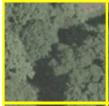
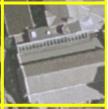
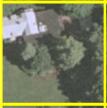
Each pixel of the land cover maps covers a 30 meter square (~100 feet) of the earth. Often, that 30 meter square is covered by one land cover class, such as trees that define forest or buildings that define developed. When a pixel covers a square that contains more then one class, it is called a mixed pixel. Every effort is taken to correctly classify the mixed pixels into the majority class, however, error can result when classifying mixed pixels.
 |
 |
 |
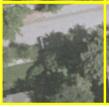 |
| homogeneous forest pixel | homogeneous developed pixel | mixed pixel with a building (developed), trees (forest), and lawn (turf and grass) | mixed pixel with a road (developed) and trees (forest) |
A demonstration of mixed pixels. The yellow outline represents the coverage of a 30 meter Landsat pixel. An aerial photo shows what might be on the ground within each example pixel. (A) and (B) represent homogeneous pixels and (C) and (D) are examples of mixed pixels.
Residential Neighborhoods with Tree Cover
Satellites see, or capture information, based on what is visible from above. Sometimes features on the earth can be "hidden" by other features. For example, houses or buildings are sometimes hidden underneath forest canopy. The land cover classification may miss houses and other structures in older neighborhoods with many large, tall trees and classify these areas as forest instead of developed. However, through the use of the rasterized roads layer, older residential developments will be identified in the land cover. Also, old and new houses may be missed if they are built in the forest with little or no clearing.